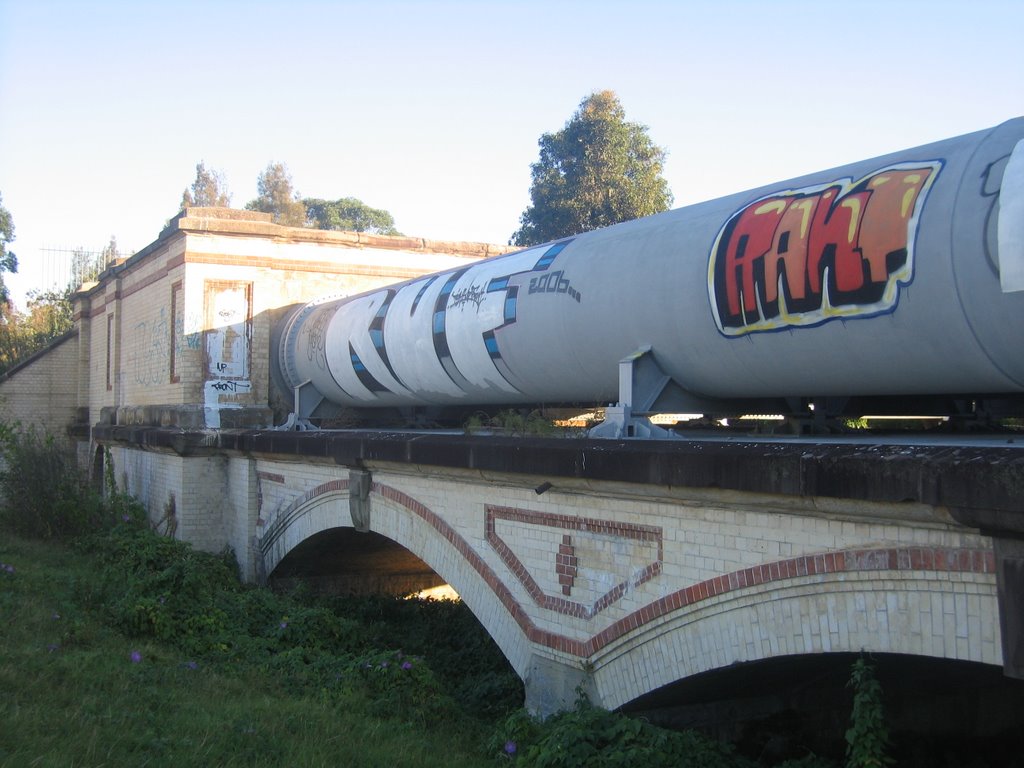
The West Botany Street Sewer Vent dates from the turn of the 20th century. It is an excellent example of the tall brick ventilation shafts which were constructed facilitate the efficient functioning of the major outfall sewers. It is a landmark which contributes to the townscape of inner southwest Sydney. The vent has been in continual use for over 100 years. Vents are important in allowing the circulation of fresh air through the sewers to reduce the production of noxious and corrosive gases (great big farts).
Historical notes - read on if particularly interested in Sydney's sewerage history (!):
In 1859 Sydney's sewerage system consisted of five outfall sewers which drained to Sydney Harbour. By the 1870's, the Harbour had become grossly polluted and, as a result, the Government created the Sydney City and Suburban Health Board to investigate an alternative means of disposing of the city's sewage. This led to the construction of two gravitation sewers in 1889 by the Public Works Department: a northern sewer being the Bondi Ocean Outfall Sewer and a southern sewer draining to a sewage farm at Botany Bay. In 1888, the new Board of Water Supply and Sewerage was created, and in 1889, it took over the old outfall sewers and the PWD new works. The new works formed the basis of the two ocean outfall sewers which still serve the greater Sydney area south of the Harbour: the BOOS - Bondi Ocean Outfall Sewer system; and the SWSOOS - Southern and Western Suburbs Ocean Outfall Sewer system. The Southern Outfall Sewer, which was the first built in 1886, ran in a southerly direction through the suburbs of Waterloo and Redfern, and reached the sewage farm by means of an inverted syphon passing under the Cooks River. The Western Outfall Main Sewer came into operation in 1898 and ran westwards from the sewage farm, before curving north to cross Wolli Creek and Cooks River to Premier Street, Marrickville and dividing into three main branches which serve suburbs such as Strathfield, Burwood, Ashfield, Drummoyne, Leichhardt, Newtown etc. The SWSOOS is now Sydney's largest sewage system, and because of its size, it is now designated in two main parts: No.1 SWSOOS which serves Sydney's more central suburbs; and No.2 SWSOOS which serves Sydney's more south-western and western suburbs. The sewer vent at West Botany Street, Arncliffe was constructed at the turn of the century in conjunction with the Western Outfall Main Sewer. Sewer vents are an essential part of sewerage systems. Their purpose is to introduce a flow of fresh air through the sewers in order to reduce the production of noxious and corrosive gases by enabling their release.