Showing posts with label The Rocks. Show all posts

Sunday, 10 April 2011

Stepping Up


Recently I showed this block of public housing flats, Sirius, in The Rocks - from the other side. This is the block from the walkway of the Sydney harbour Bridge. This aspect shows the roof terraces which are an integral part of the design.

See the previous entry by clicking here.

Monday, 4 April 2011

Observatory Hill


Looking over The Rocks (Millers Point) and Sydney Harbour from Observatory Hill

Thursday, 31 March 2011

Sydney Architecture Walk 4 : KIng George V Recreation Centre


What's "wrong" with the view through the arches?

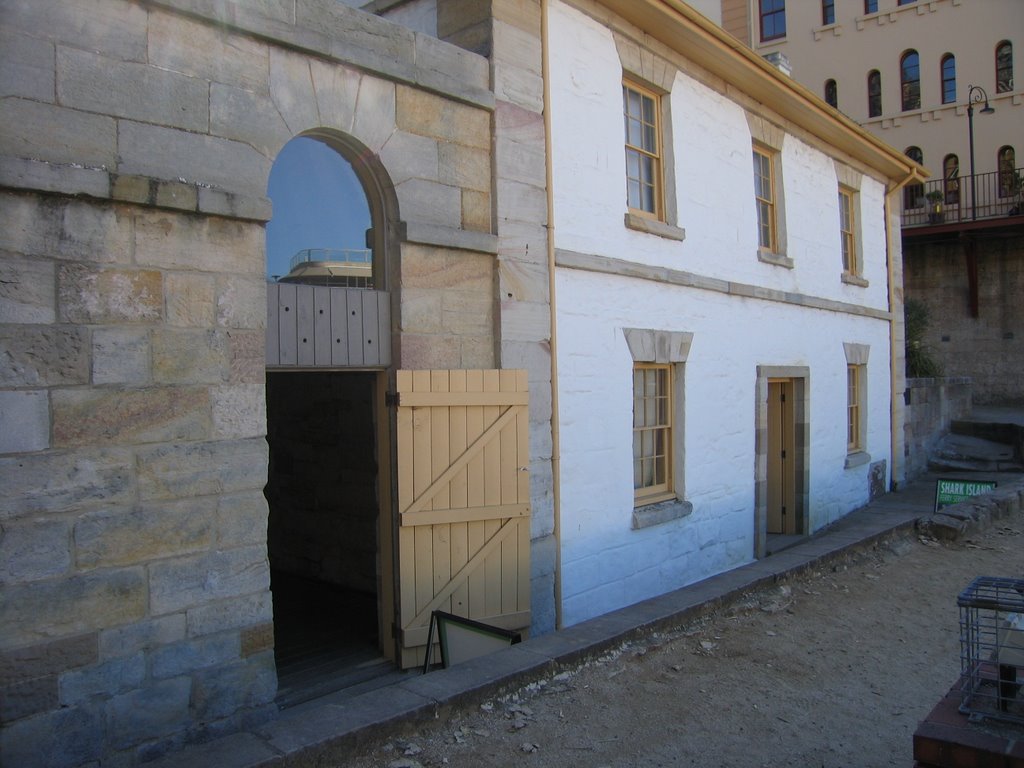
A City of Sydney sports facility in The Rocks. Another controversial-at-the-time building. The City originally wanted a building reflecting the old,  brick buildings, but the architect chose instead to reflect the industrial heritage of the area.

As part of the development the mural was required to be saved, and it forms a striking wall of the outdoor court. It almost accurately reflects what is on the other side of the wall which forms part of the Harbour Bridge approach access. It was painted by Peter Day in 1983.

Tuesday, 29 March 2011

Sydney Architecture Walk 3: Sirius and Green Bans


Sirius is a public housing development in The Rocks. It was built in 1979, after the decade long Green Ban protection of The Rocks. It was symbolic of the fact that public housing was there to stay, right in the centre of an area potentially ripe for development for the very rich. Although concrete, and an example of 'brutalism', the rooftops all have private or community terraces. The wanted to use architect, Tao Gofers, from the government architect's office wanted to use white cement, to echo the Opera House across the water, but there was no budget for it. It is designed to allow plants to grow over it. Fifteen metres on the other side is the approach to the Harbour Bridge, so the vegetation helps baffle noise. This is an extremely popular place to live.

The 'Green Bans' were a coalition of the Rocks Residents' Action Group, and the union called the Builders Labourers' Federation who combined to prevent demolition of the historic Rocks precinct with its low-income housing. I have blogged about Green Bans before: see here. More about Green Bans here.

More here about Sirius here.

Monday, 6 July 2009

Campbell's Cove


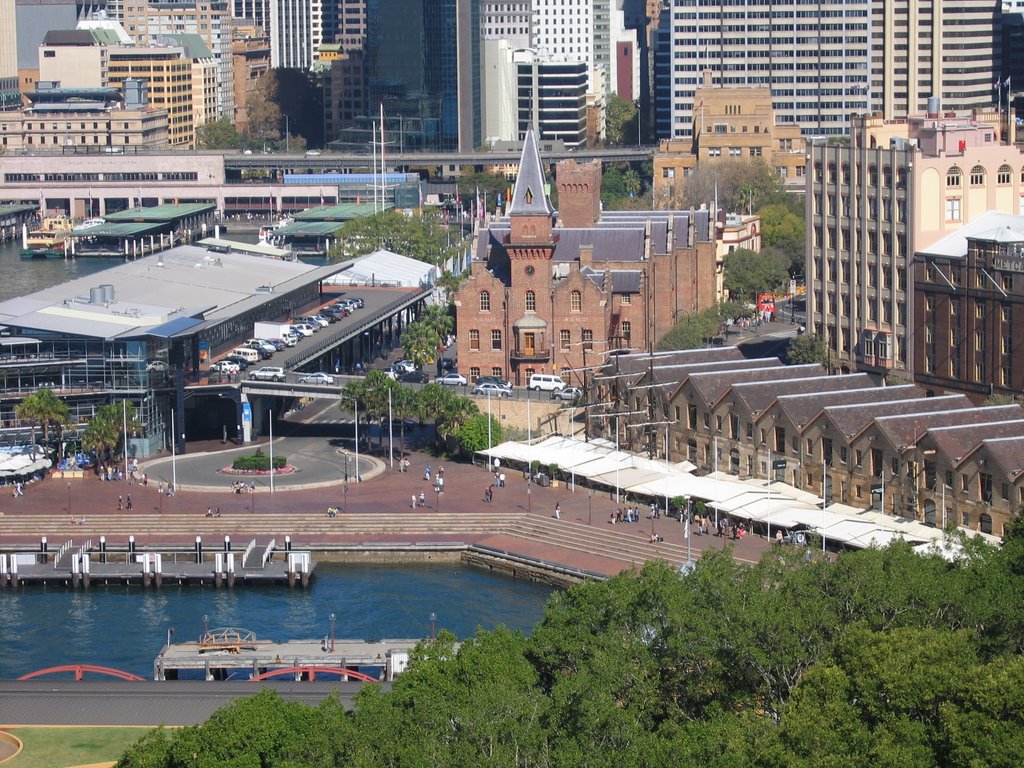
Campbell's Cove at west Circular Quay is an area of jazzed-up waterfront. The former bond stores are now upmarket restaurants. The glass and steel building at left in the photo at left is the Overseas Passenger Terminal where the large cruise ships tie up. The bar I showed two days ago ("Cruise Bar") is in this building looking out over the water.

The distinctive looking building with the spire was built 1883-4 and is of Anglo-Dutch design. It was the Australiasian Steam Navigation Building and was a warehouse. It is now a gallery space and theaterettes.

Campbell Cove is named after Robert Campbell, a prominent Scottish merchant in the early days of Sydney. He purchased this land in 1799 and constructed a private wharf to house imports such as sugar, tea, and spirits from India. He was the only merchant that broke the monopoly held by the British East India Company. From 1838, he began construction of 5 sandstone bays (Campbell Storehouses, which is where the restaurants are now.)

These photos were taken last Saturday. How's that for a brilliant winter sky!

Friday, 12 June 2009

Vivid Sydney - Vessel of (Horti) Cultural Plenty

Light sculpture by Sydney artist Warren Langley, forming part of the Smart Light exhibition as part of the Vivid Sydney festival (26 May - 14 June). One aim of the festival was to demonstrate the use of light through energy efficient means. This sculpture uses LED lights, and along with all the others, uses minimal electricity. The festival is accompanied by a programme of talks and other events discussing ideas, and ....light!

Thursday, 11 June 2009

Vivid Sydney - Argyle Street

The trees in Argyle Street illuminated during the Vivid Sydney Smart Light exhibition - jewel colours.


Wednesday, 10 June 2009

Vivid! The Opera House sails alight.

As part of the Vivid Sydney festival, the sails of the Opera House are used as a canvas for an ever-changing light show. Every night from 6pm to midnight, between May 26 and June 14, the sails are lit with rich, continuously changing configurations of colour. What a "canvas" ! The curator of the exhibition, and artist responsible for these illuminations is Brian Eno. Perhaps he's better known as a musician, he also works as an artist.

Above: Each design lasts for between 5 and 20 minutes.
Below: The sails peeping up from our vantage point in Cumberland St, above Argyle St in The Rocks. Tomorrow we'll see more of that colourful tree at the right.


Saturday, 13 December 2008

The Argyle Cut: Sydney Sandstone Tour Part 6

It looks a bit like an Italianate loggia, but it is the staircase to the cycle way across the Sydney Harbour Bridge, taken from the sandstone cutting in Argyle St, The Rocks - "The Argyle Cut". It was a major early engineering feat, begun by convicts in 1843 by convicts with hammers and chisels, and completed in 1867 with the help of explosives. For some time until 1900 it was the underground home of thugs, petty gangsters and rats. The site was cleaned up after the plague forced authorities to sanitise the area.

While Sandstone gives Sydney it's paerticular "look", at first it was seen as a hindrance because the sandstone is not very far below the surface, and the soils are thus thin and sandy. It was not very good for agriculture. The earliest housing was made from people hewing out the stone, literally from their own backyards, and making themselves a little rock cottage on The Rocks. Very early on, the convicts were put to work, quarrying out huge amounts of sandstone so that by the 1830s they were tunnelling the Argyle Cut.

Using sandstone for major public buildings took off in the 1850s. Skilled masons came from Scotland, France and Italy in the 1870s. It fell out of favour in the 20th century as skyscrapers of glass and steel came to dominate, and there were attempts to demolish some of the most magnificent examples, but fortunately actions in the 1960s and 70s saved many of them. I'll start showing some of Sydney's wonderful buildings from tomorrow.

Tuesday, 9 September 2008

The Garrison Church


The colony's first military church, was built in 1840 for the soldiers to attend services. It was enlarged in 1855 to accommodate 600 people. It is still used, and still associated with the armed forces. The architects were Henry Ginn and Edmund Blacket.

It is found in the oldest part of Sydney, The Rocks.

Monday, 8 September 2008

Police Station, The Rocks

The traditional blue police light in The Rocks.

Why are police associated with the colour blue in so many places - blue uniforms, the thin blue line, blue lights, blue call boxes (the most famous of which is the TARDIS*: and if you don't know what that is, well, you've led a culturally deprived life ;-) ?

It seems it dates back to the first organised police force in the world, Sir Robert Peel's Metropolitan Police in London.

When formed in 1829 it was decided that their uniform should be completely different in all ways to the uniform worn by the military which had been used for policing major disorder in London and the rest of the country. So, they had a civilian uniform of blue high collared tailcoat, worn with white trousers and hardened top hats, as opposed to red uniforms of the military. The top hats, by the way served the dual purpose of providing head protection and acting as a step to allow officers to climb or see over walls!

* TARDIS: see here

Friday, 29 August 2008

Costa Living

NSW public sector workers, including the fire brigade, are looking for pay increases more than what the state treasurer and givernment is offering - 2.5%. Inflation is currently over 4%, so it would mean an effective pay cut.

The name of the Treasuer is Michael Costa, so this banner on the side of the fire engine is a "cost of living" pun on his name.

Wednesday, 6 February 2008

Saturday, 19 May 2007

Not Napoleon Bonaparte

At least one person who visited Sydney left with the impression that this is a statue of Napoleon Bonaparte. She probably isn't the only one.

Despite the wonderful bicorn hat, this isn't the Little General. Nevertheless the subject of this sculpture by Marc Clark, which is in The Rocks, looking over Sydney Harbour, had a pretty interesting story.

He was William Bligh, was the fourth Governor of the colony of New South Wales (August 1806 - Jan 1808); the same Bligh who suffered mutiny on the Bounty in 1789. Bligh faced another mutiny in Sydney during the "Rum Rebellion" in 1808, when the military, known as the "Rum Corps", ordered his arrest. The Rum Rebellion was the only successful armed takeover of government in Australia's recorded history.
In 1809, Lieutenant Colonel Lachlan Macquarie arrived in Sydney (Governor 1810-1821) to restore order and the "Rum Corps" was ordered back to England.
Does anyone know the reason (or can anyone make up a story!) why the British military was known as the "Rum Corps" ?
The Rum Rebellion is one of the most interesting stories of Australia's colonial history. If you are interested, you can read more about it here. And here's an interactive graphic novel about William Bligh. Perhaps a better memorial to Bligh is the replica of the Bounty that sails around Sydney Harbour these days. It was built for the movie starring Mel Gibson.

Tuesday, 20 March 2007

Bubonic Plague


(Click on the photo to enlarge in order to read it)
There's some more historical information about the outbreak of plague in Sydney in 1900 here.
Has there ever been an outbreak of plague, or other epidemic in your city?

Friday, 16 March 2007

Cadman's Cottage


This cottage, in the historic Rocks area of Sydney was built in 1816. It is the oldest surviving residence. The first shelters built by Europeans were wattle and daub huts, or wooden slab huts. None of those exist any more. More here.

Wednesday, 22 November 2006

Circular Quay and The Rocks

In the background, Circular Quay, from whose docks (with the low, green roofs) ferries leave for points all around Sydney Harbour. The long, modern building in the middle left is the Overseas Passenger Terminal, where huge cruise ships berth (Nathalie posted one recently). The building in the centre was a warehouse of the Australasian Steam Navigation company (previous post). Behind it, the yellowy building was once the headquarters of the Water Board, but is now the acclaimed Museum of Contemporary Art. Finally, the line of warehouses in the foreground right are now (expensive) restaurants, very popular with tourists and their Sydney hosts. This is the oldest part of Sydney, known as "The Rocks".

Friday, 14 July 2006

Dutch inspiration


This building was built 1883-4 and is of Anglo-Dutch design. It's located in The Rocks area of Sydney, where many of Sydney's oldest buildings are located. This is the Australiasian Steam Navigation Building and was a warehouse. Of course, shipping has played a critically important role in Sydney's history. It is now a gallery space and theaterettes. It currently features art works by Nelson Mandela.

Thursday, 22 June 2006

George St Pissoir

This pissoir in George St, Sydney dates from the 1880s.
You can read all about it here.

And there's some additional photos here.