Showing posts with label Aborigines. Show all posts

Thursday, 29 November 2012

Illawarra Flame Tree


Photos taken 29 Nov 2012 on iPhone 4S
A contrast to the lavendar of November jacarandas is the native Illawarra flame tree. They are often planted alongside each other. This specimen is in Arncliffe Park.

The Illawarra flame tree (Brachychiton acerifolius)  is native to subtropical regions on the east coast of Australia. Sometimes it is called a Kurrajong, like other brachychitons of which it is a relative.
The flowers are bell-shaped, and it has pod-like fruit, which contain masses of thin bristles and seeds. The seeds were eaten by Aborigines after toasting.

Monday, 29 October 2012

Aboriginal rock engravings


Excavations at an old industrial site, a coal loader, at Waverton, unearthed several Aboriginal rock engravings. Read more here

Canon PowershotG12 28 Oct 10:47am


Thursday, 26 January 2012

Australia Day: Invasion to Reconciliation (Parramatta)

These images are part of the walkway along the Parramatta River.

On 26 January 1788, the First Fleet under Captain Arthur Phillip arrived in Sydney Cove. Parramatta, 23 kilometres west, was also established in 1788, after food growing failed in the poor soils around Sydney Cove. The indigenous Dharug people had known this as an area of rich food resources for thousands of years. It is the point where salt water becomes fresh, so also useful for farming.

Baludarri the Young Warrior, from Parramatta, befriended Governor Phillip and lived at Government House in Sydney from late 1790 to early 1791. He then left to return to Parramatta for a seasonal fishing trip, and encouraged by Phillip began to trade fish with new European residents of Parramatta.  

While fishing, convicts destroyed his fishing canoe. Phillip intervened and promised that the convicts would be punished if Baludarri did not kill a white man.  However, enraged at the act, Baludarri sought traditional revenge and speared a convict. Phillip learned of this and ordered Baludarri be outlawed and shot. Phillip later relented when he learned Baludarri had a fever. Baludarri died in late 1791 and was buried in the Governor's garden.

Between 1791 an 1805 a guerilla war was fought between Aboriginal people and whites. Aboriginal people defended their land ferociously from the appropriation following invasion. However, the arms available to the colonists ensured battle superiority. As well, the smallpox (an introduced disease ) epidemic of 1789 hit the Indigenous people very hard.

One leader, Pemulwuy, speared and killed Governor Phillip's gamekeeper, in revenge for the gamekeeper killing a large number of Aboriginal people. Phillip dispatched 50 soldiers with orders to bring back the hearts of any 6 men belonging to Pemulwuy's group. 

Pemulwuy led a series of attacks on farms. He was ambushed and killed in 1802. 

Reconciliation

In 1805, local Indigenous representatives and a settler, John Kennedy, initiated a 'Peace conference' at Parramatta. It was described as 'a conference with a view of opening a way to Reconciliation.' This was one of the earliest uses of the word in Australia - a first attempt at Reconciliation of Indigenous and non-Indigenous people in Australia.

This goal remains one to strive for.

Monday, 23 January 2012

Parramatta


The eel and the convergence of salt and fresh water.

Before the arrival of Europeans in 1788, the Sydney area was occupied by three Aboriginal groups. In the Parramatta area, it was the Burramatagal clan of the Dharug group.

The word "Parramatta" was first used in June 1791. It is derived from Burramatta, a literal translation of which is "place where the eels lie down".

Some species of eel migrate from salt water to fresh water to spawn. The eels migrate up the Parramatta River, and the name is probably associated with that. Parramatta is located at the convergence of salt and fresh water. The river flows into Sydney Harbour.

This section of the riverside walk represents the importance of the eel to the Indigenous people.

Thursday, 4 March 2010

Mural, Reconciliation Park, Redfern


A frill-necked lizard is the feature of this detail from the mural. See also the past two entries for information about the park, the mural and the Public Art Squad which created it.

Wednesday, 3 March 2010


More details from the mural in Reconciliation Park, Redfern, which I showed yesterday.

In the previous post there is a link to more information about the park, which also has an overview shot of the mural.

Tuesday, 2 March 2010

Mural, Reconciliation Park, Redfern

The suburb of Redfern has become synonymous with Aboriginal people because of the Aboriginal Housing Company area near Redfern Station and the Redfern Park speech in 1992 which redefined Australia’s attitudes to its indigenous people.

The mural on the side wall of 17 George Street was commissioned by Sydney City Council and painted by the Public Art Squad. Entitled ‘Think Globally Act Locally’, it won the Sir John Sulman art prize in 1985.

More information here.

And more mural detail tomorrow.

Tuesday, 7 July 2009

NAIDOC Week 5 -12 July


NAIDOC - National Aboriginal and Islander Day Observance Committee - Week is a celebration of Aboriginal and Torres Strait Islander cultures and an opportunity to recognise the contributions of Indigenous Australians in various fields.

Above: The 2009 NAIDOC Week poster features artwork by Queenslander Luke Mallie, winning artist of the National NAIDOC Poster Competition. Luke's artwork, created from acrylic, water colour and ink on paper, is titled Carrying On Our Culture and was judged the winner from a record 140 entries.

"Carrying On Our Culture was painted to reflect the 2009 NAIDOC Theme Honouring Our Elders, Nurturing Our Youth. It represents the elders teaching and keeping watch over their young as they learn and grow into adults to then carry on the culture."

"The painting also depicts past elders who watch over everyone to protect and guide us through our lives. We all have the ability to connect to those spirits if we need guidance or inspiration."

Sydney City Council's banner at left is the work of artist Bronwyn Bancroft, a Djanbun (pronounced Jaan’bun) woman from the Bundjalung (Bun-jaa-lung) Nation of Northern NSW. She was born in a small country town in regional NSW, but lived most of her adult life in Sydney. She is a well known Aboriginal artist who has exhibited her work both nationally & internationally. Bronwyn Bancroft stated, “I am pleased that the design will be used throughout the city, as I would love to see more permanent visual Memorials to Aboriginal People…Past, Present and Future.”

Activities take place across the nation during NAIDOC Week in the first full week of July. All Australians are encouraged to participate.

The theme this year is Honouring our Elders, Nurturing our Youth.

NAIDOC Week grew out of a "Day of Mourning" held in 1938. The Day of Mourning was declared due to the lack of response from the Commonwealth government to a petition from Aboriginal people in 1935 and 1937 seeking representation in the Parliament and the establishment of a national department of native affairs and state advisory councils.

Thursday, 18 June 2009

Redfern Park - Inspiration for a photographer


A new feature of Redfern Park since its refurbishment is this water feature. The interactive water feature is a cross formation of lotus lily stems reaching two metres in height with pop jet water features and water rill channels for water play. It is located in the area designed for young children to play.

At one end is a memorial plaque to Michael Riley, a local Aboriginal artist/photographer, Michael Riley. You can read more about Riley here: Message Stick, and see many of his works here: Sights Unseen.

The plaque reads:

Michael Riley 1960 - 2004
Of the Wiradjuri and Kamilaroi People

"I found I wanted to tell stories and get stories from Aboriginal people."

Michael was born in 1960 in Dubbo. Aboriginal people of Michael's generation thrived both in numbers, vocal visibility and artistic achievement.
His generation was a line of sophisticated people who fell between, in Michael's words, 'The Trad Ab and the Rad Ab' but wh developed into worldly art practitioners and stylish urbane personalities.

His quiet seemingly aloof demeanour actually belied a deep thinking person of extreme warmth, humour and generosity. Michael's poignant insightful frames and landscapes express the universal search for an historic spirituality. Initiially there was the dreaming, but if this is lost, what replaces this guiding core of our lives? The relationship (and attendant issues), to some degree go beyond questions of indigenity alone. Equally he is loved and missed.

Djon Mundine OAM

"Aboriginal spirituality is still there within the land even if the surface has changed there's still a sense of beauty and spirituality there."

Wednesday, 10 December 2008

Aborigines of Sydney (Sydney Sandstone Part 3)


The sandstone overhangs of the Sydney coast and bush provided great shelter for the original inhabitants, the Aboriginal people. There are also a fair few sites where rock carvings are still evident (I don't have any pics at the moment).

Above: Kurnell on Botany Bay.

Below: Nannygoat Hill, Bardwell Valley. This wonderful piece of remnant bushland is only a few kilometres from the centre of Sydney and right near where I live. Walk up Nannygoat Hill here, and here.


About the Aboriginal people of the Sydney region
The original inhabitants of the area shown in Photo 2 were (perhaps) the Gweagal clan of the Dharug Nation. There does seem to be some confusion about this. One source , the National Trust, says that the Gweagal people lived on the southern side of the Cooks River as far as the Georges River, from the shores of Botany Bay inland towards Liverpool. Other sources such as the map linked below, place the Gweagal people on the south side of the Georges River, and the group around Nannygoat Hill is named as the Gameygal.

Anyway, the river provided fish, oysters, crustaceans, waterfowl and the valleys birds, eggs, possums, snakes, wallabies, goannas, wild honey, berries and nuts - in short, an abundant food supply.

Valleys of Wolli Creek and Bardwell Creek contain evidence of Aboriginal presence in smoke-blackened caves. (I took this photo on Nannygoat Hill *, a rocky outcrop amongst a stand of bushland along Wolli Creek). However, it appears that these may have acted as temporary shelters only for hunting parties, as the people lived more permanently along the abundant shores of Botany Bay. Middens have been found along the Bay, and the river, and were one source of lime in the days when lime was burned in order to provide the substance for the bricks and mortar for Sydney buildings.

The northern part of Arncliffe (now a high-rise housing subdivision called Wolli Creek) and some parkland is bordered by the Cook's River, named after - well, yes - Captain James Cook.

You can meet a Gweagal man, Rod Mason, an Aboriginal Discovery Ranger at Botany Bay National Park, at this website of the National Parks and Wildlife Service.

This map of the clans of the Sydney area, definitely places the Gweagal people at Kurnell.

Wednesday, 8 October 2008

Kuku Yalanji bama - The Land of the Yalanji people

Above: Cameron, our Yalanji guide shows us the use of the Karrandal (Latin Alphitonia philippinensis; English - Soap Tree) - by crushing it a lather is produced. The soap also has antiseptic qualities. It smells of linament - nature's Dencorub!)

Before Captain Cook foundered on a reef off Cooktown, before the cane-growers and dairymen, and tourists arrived in the land from Mossman to Cooktown, there lived the Yalanji bama (Yalanji people), taking care of the land and having the land take care of them.

At Mossman Gorge you can take a guided walk through the rainforest with the traditional owners and custodians of this land. The wonderful Cameron taught and showed us things we never would have learned or seen otherwise. It was fabulous to have someone so enthusiastically share aspects of his traditional culture with us.
Below: Ochres mixed with water were used for body decoration. The dots represent raindrops, the stripes the rivers.

Wednesday, 13 February 2008

Sorry

Photo above from the Sydney Morning Herald


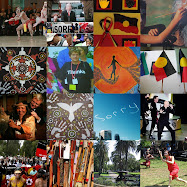
Montage above (left to right, top to bottom):

Welcome ceremony, Parliament House Canberra Tue 12 Feb 2008 (Sydney Morning Herald); The Prime Minister, Kevin Rudd, delivers the apology and faces around the country (SMH); My artist trading card "Reconciliation"; detail from poster; detail from poster; woman wearing "Thanks T-shirt, Parliament House crowd (ABC TV); detail from poster; Aboriginal and Torres Strait Islander flags; Kevin Rudd with Matilda House, who delivered a Welcome to Country at Parliament House 12 Feb 2008; art work; 'Sorry' in skywriting, over Sydney Harbour; Midnight Oil perform at Sydney Olympics wearing "sorry" clothes; march; didgeridoos; Redfern Park - an important venue in the history of "Sorry"; cleansing ceremony, Australia Day 2008.

An amazingly emotional, and unprecedented day in Australian history. The new Prime Minister, Kevin Rudd, presented the first motion of the new Parliament. It was to say "Sorry" on behalf of Government and Parliament to the Stolen Generations, their families and communities. The Stolen Generations were those Indigenous people taken as children from their families because of government policy between 1910 and 1970. Their "sin" was to be born Aboriginal. Official policy of the time was to "breed out" Aboriginality. The forcible removal of children was meant to effect this over time.

You can hear the Prime Minister's speech, which includes much of the history of these institutionally racist policies, and see a lovely multimedia presentation here.

In 1997 a report titled "Bringing Them Home" documented the harrowing accounts of many who were stolen. Amongst other things, it recommended that as a first step towards Reconciliation an apology be made to the people for the wrongs and traumas that had been endured. The previous Prime Minister refused to utter that most simple and eloquent of words - "Sorry" .

On May 28 2000, 250,000 people walked over Sydney Harbour Bridge to express their support for Reconciliation between Australia's Indigenous and non-Indigenous Australians. Read about that moment here.

On 10 Dec, 1992 then Prime Minister, Paul Keating, who commissioned the Bringing Them Home report, had gone to Redfern Park and made a speech which set the tone for Reconciliation. Read the speech here. Keating, along with other former Prime Ministers, Gough Whitlam (1972-75), Malcolm Fraser (1975-83), Bob Hawke (1983-1991), Paul Keating (Dec 1991-1996) were present to support the apology. The only living ex-PM who didn't attend was the immediate past one, John Howard. His party, however, supported it today.


Saturday, 14 July 2007

le quatorze juillet

"How to mark Bastille Day on Sydney Daily Photo, with an Aussie flavour? " I wondered.

Well, I think there's only one place in the world* you might come across these three flags flying together: La Perouse, on the northern shore of Botany Bay. The Australian flag, the French flag, and the Aboriginal flag (La Perouse is home to a large Aboriginal community)

French Captain Jean-François de Galaup, Comte de Laperouse, arrived here just six days after the British First Fleet in 1788. Laperouse stayed in Botany Bay for six weeks, building an observatory, stockade and garden. This monument marks the site of his camp.


Today when I arrived there was a group of French speaking young people just packing up musical instruments; I had missed celebrations featuring the Orchestre Polyphonique from Île de la Réunion. Which just proves how even-handed I am, because I also missed the 29 April celebrations on the opposite side of Botany Bay, commemorating the arrival of Captain Cook! (see this blog)


* Hmmmm- perhaps at the Musée Branly in Paris, which has a modern Aboriginal art collection?

Saturday, 26 May 2007

Sorry Day


Only forty years ago, the original inhabitants of Australia, the Aboriginal people, were not counted as people in Australia. A referendum held on May 27, 1967 enabled a change to occur which meant that the Australian Constitution was changed in two ways, so that the Commonwealth government would be able to make laws relating to Aboriginal people*, and allowing Aboriginal people to be counted in the national census* (more about the changes below).

Forty years ago tomorrow, more than 90 per cent of Australians voted in favour of the changes.

One important outcome has been that the referendum has acquired a symbolic meaning in relation to a period of rapid social change during the 1960s.

Many injustices were (and many remain) evident. In 1965, Aboriginal Freedom Rides were organised, whereby buses of Aboriginal and non-Aboriginal people visited country towns where there were, for example, laws preventing Aboriginal people using local swimming pools.

Throughout white history of Australia, children had been forcibly removed from their families.

Ten years ago, on May 26, 1997, a Human Rights and Equal Opportunity presented the findings of the National Inquiry into the separation of Aboriginal and Torres Strait Islander children from their families - the "stolen generation" - in a report entitled Bringing Them Home. This part of our history still affects many Aboriginal people today. It is not ancient history, it is part of the experience lived by many able to tell their story today. Many many of the recommendations have never been implemented, including a refusal by the federal government to say "Sorry" (hence the naming of today "Sorry Day"). Others (mainly but not exclusively, non-Aboriginal) argue that such symbolism is now unnecessary - it is all too long ago, and there are other things to get on with; others argue that without truth and acknowledgement of past wrongs, little can be achieved in the future.

In 1991, a Royal Commission into Aboriginal Deaths In Custody presented its report. Many of the recommendations are yet to be properly implemented. Further information here.

On May 28, 2000, more than 250 000 people walked across Sydney Harbour Bridge in support of reconciliation, and more than a million Australians across the country participated in similar marches. My blog on 26 January this year shows the plaque commemorating the event. And below are my (scanned) photos from that day.

There's a walk and gathering in Sydney today to mark these occasions. Unfortunately I can't attend but above is a copy of an Artist Trading Card I made recently, called 'Hands Up For Reconciliation'.

* The first was a phrase in Section 51 which stated that the Federal Government had the power to make laws with respect to "the people of any race, other than the Aboriginal race in any State, for whom it is deemed necessary to make special laws." (This is known as the "race power.") The referendum removed the phrase "other than the Aboriginal race in any State," giving the Commonwealth the power to make laws specifically to benefit Aboriginal people.

* The second was Section 127, which said: "In reckoning the numbers of the people of the Commonwealth, or of a State or other part of the Commonwealth, Aboriginal natives shall not be counted." The referendum deleted this section from the Constitution.

More info about significant events in Aboriginal history.


My Reconciliation Walk photos from 28 May 2000.

It was amazing being part of such a huge crowd with hope int heir hearts and goodwill. Unfortunately, Aboriginal life expectancy is still 17 years below that of non-Aboriginal Australians, education outcomes are poorer, and infant mortality unacceptable high. Despite the stereotypical image, the majority of Aborigines live in urban and regional, populated areas, not the remote areas of the outback. Most of those Aborigines have long been dispossesed of their land and clan and family identity.

Friday, 26 January 2007

Reconciliation - when? Not on Australia Day 2007.


This is a picture of Sydney Cove, taken from a significant point on the Sydney Harbour Bridge.

On 21 January, 1788, Captain Arthur Philip and the First Fleet, a raggle taggle collection of convicts and hardly-better British soldiers, reached Sydney Cove (the water in this picture) to establish a British convict colony.

On 26 January, the British flag was raised at Sydney Cove and the colony officially began.

Captain James Cook had sailed along the coast 18 years earlier, and had stopped in Botany Bay, south of here. Cook saw the entrance to the harbour on May 6, 1770, and named it Port Jackson, after a friend, one of the secretaries of the British Admiralty, George Jackson. He noted that it looked like a good anchorage, but decided to sail on, so he never entered this magnificent harbour. Cook, and his botanist, Joseph Banks, recommended a settlement at Botany Bay, however Philip found it did not possess a reliable fresh water supply, so after anchoring there on 18 January 1788, decided to move on to explore the possiblity of the anchorage at Port Jackson. Philip and the First Fleet arrived here on 21 January, and named it Sydney Cove. There was a stream, the Tank Stream, for water.

On 26 January, 1788, Philip raised the British flag and so founded the colony. That occasion id now commemorated as Australia Day, a public holiday.

That act also signifies the dispossession of the land from its original inhabitants, the Aboriginal people, although that was probably not the original intention.

A doctrine was used in British law, known as terra nullius (empty land) - now overthrown in Australian law. It asserte that the land was empty of people, and thus free for the taking. Cook had thought, because he encountered so few people around the coasts, that the interior must be empty.

In fact living in this very place were the Gadigal people of the Eora nation, Philip was under instructions to be friendly and to treat with them. A subsequent governor (Macarthur) went back to England to get terra nullius invoked, when he wanted to clear Aborigines from land he wanted to expand into.

This has led to more than 2 centuries of injustice towards the Aboriginal people.

At the southern end of the walkway across the Sydney Harbour Bridge, a plaque commemorates the Reconciliation Walk of 28 May 2000. On that say, there seemed like there was enormous hope for reconciliation between Australia's Indigenous and non-Indigenous people, as referred to yesterday. Under the policies of the current federal gocernment, that hope has dimmed - I hope temporarily. Now THAT will be a day to celebrate!!

The plaque reads:

On 28 May 2000, more than 250,000 people walked across the Sydney Harbour Bridge in support of reconciliation. In the months that followed a million more Australians participated in similar walks throughout the nation. Mari budjari yana. Unveiled on 27 May 2004


Thursday, 25 January 2007

Redfern Park. Redfern Speech.


On 10 December, 1992, the Australian Prime Minister at the time, Paul Keating, made a speech at Redfern Park which offered great hope for the future of relations between Aboriginal and non-Aboriginal Australians. You can read the 'Redfern Speech' here. Along with Keatings speech at the tomb of the Unknown Soldier in Canberra, I rank it as one of the great speeches of Australian history.
Unfortunately, since that time, under an exceptionally conservative government, the hopes expressed here were not realised, and relations have, if anything, deteriorated.
Redfern is an inner suburb of Sydney with a large Aboriginal population.
Tomorrow is Australia Day which commemorates the date of the first European settlement in Australia. I will have more to say about Reconciliation between Indigenous and non-Indigenous Australians tomorrow.

Wednesday, 10 January 2007

Burial site


Developments along the coast are always controversial, particularly when there is a site of Aboriginal significance involved. Here it is known there is a former Aboriginal burial site.
The Minister for Planning approved the development.
This advertising sign had disappeared the day after I took the photo.

Monday, 20 November 2006

Aboriginal canoe tree

Between Malua Bay and Moruya on the NSW south coast is this tree which once had the makings of an Aboriginal bark canoe carved from it. It's seen a bit of vandalism since, and is now surrounded by a high wire fence for protection. Pity that some people can't just leave alone, and value our shared cultural heritage.

This is near where I've been hanging out the past few days.

Friday, 2 June 2006

Museum of Sydney

This installation is in front of the Museum of Sydney. Called Edge of the Trees, it is by Janet Laurence and Fiona Foley. It is the first public artwork in Sydney to be a collaboration between a European and an Aboriginal Australian.

"From the edge of the trees the Cadigal people watched as the strangers of
the First Fleet struggled ashore in 1788. We can only imagine what their
thoughts would have been. This sculptural installation by artists Janet
Laurence and Fiona Foley symbolises that first encounter. Richly embedded with
materials and language, the sculpture evokes layers of memory, people and
place."

http://www.hht.net.au/collections/museum_of_sydney

You can walk among the massive pillars - some inscribed with the names and words of those who arrived with the First Fleet in 1788 or Eora people, others with glass panels through which you can see human hair, ash, feathers or other organic matter suggesting the physical traces of the past - and listen to the haunting, evocative sounds of Eora speech.

Friday, 28 April 2006

Didgeridoos for sale


Souvenir didgeridoos (and kangaroo glove puppet) for sale in Sydney. You can listen to some didgeridoo music and learn all about them here and here.