This historic house is very near where I live. You can read more about it in my previous blogs.
Showing posts with label Historical. Show all posts
Thursday, 3 December 2015
Saturday, 5 July 2014
Mark Foys
The steps of the long-gone Mark Foys department store. It is now the Downing Centre court complex.
You could be forgiven for thinking it's a scene featuring a very elegant young woman with her child and mother in Rome.
Elegant they are, and very "modern" - they're not wearing gloves for the big trip to "town".
The year was approx 1955. The elegant young woman (aged about 20) is my mother-in-law, the older woman her mother, and the boy is my husband.
I love this photo!
Monday, 23 June 2014
Moratorium
In the late 1960s and early 1970s, opposition to the war in Vietnam had grown to a huge mass movement.
This piece of remnant graffiti promoting the cause still exists (as of yesterday!) in the railway underpass at Arncliffe in Sydney. I wonder if there is any elsewhere?
The Moratorium against the Vietnam War began in the United States, with the first Moratorium march on 15 October, 1969. This followed anti-war marches on the United Nations and Pentagon in 1967. On 15 November, 1969, 500,000 people marched on Washington DC.
In Australia the first marches took place on 8 and 9 May, 1970. Over 200,000 people took part, 100 000 in Melbourne. It was the largest mass movement against the war to that time. The second was in September 1970 and the third in July 1971. By this time, public opinion was turning decisively against conscription and Australia's involvement in the war.
Monday, 29 October 2012
Aboriginal rock engravings
Excavations at an old industrial site, a coal loader, at Waverton, unearthed several Aboriginal rock engravings. Read more here
Canon PowershotG12 28 Oct 10:47am
Sunday, 21 October 2012
Thursday, 26 January 2012
Australia Day: Invasion to Reconciliation (Parramatta)
These images are part of the walkway along the Parramatta River.
On 26 January 1788, the First Fleet under Captain Arthur Phillip arrived in Sydney Cove. Parramatta, 23 kilometres west, was also established in 1788, after food growing failed in the poor soils around Sydney Cove. The indigenous Dharug people had known this as an area of rich food resources for thousands of years. It is the point where salt water becomes fresh, so also useful for farming.
Baludarri the Young Warrior, from Parramatta, befriended Governor Phillip and lived at Government House in Sydney from late 1790 to early 1791. He then left to return to Parramatta for a seasonal fishing trip, and encouraged by Phillip began to trade fish with new European residents of Parramatta.
While fishing, convicts destroyed his fishing canoe. Phillip intervened and promised that the convicts would be punished if Baludarri did not kill a white man. However, enraged at the act, Baludarri sought traditional revenge and speared a convict. Phillip learned of this and ordered Baludarri be outlawed and shot. Phillip later relented when he learned Baludarri had a fever. Baludarri died in late 1791 and was buried in the Governor's garden.
Between 1791 an 1805 a guerilla war was fought between Aboriginal people and whites. Aboriginal people defended their land ferociously from the appropriation following invasion. However, the arms available to the colonists ensured battle superiority. As well, the smallpox (an introduced disease ) epidemic of 1789 hit the Indigenous people very hard.
One leader, Pemulwuy, speared and killed Governor Phillip's gamekeeper, in revenge for the gamekeeper killing a large number of Aboriginal people. Phillip dispatched 50 soldiers with orders to bring back the hearts of any 6 men belonging to Pemulwuy's group.
Pemulwuy led a series of attacks on farms. He was ambushed and killed in 1802.
Reconciliation
In 1805, local Indigenous representatives and a settler, John Kennedy, initiated a 'Peace conference' at Parramatta. It was described as 'a conference with a view of opening a way to Reconciliation.' This was one of the earliest uses of the word in Australia - a first attempt at Reconciliation of Indigenous and non-Indigenous people in Australia.
This goal remains one to strive for.
Friday, 21 October 2011
Space ship?
This "spaceship" appears to have landed in Wynyard Park in Sydney. It allows light in to the underground entrance to Wynyard railway station.
I think it's rather elegant, and "Parisian", matching the nearby AWA tower / mini Eiffel Tower, which dates from 1939.
It was Australia's tallest building until 1958. It has a viewing platform which is no longer open to the public. AWA was a communications company and it was a radio transmission tower.
Thursday, 16 June 2011
Passengers
Wednesday, 15 June 2011
Tuesday, 14 June 2011
Loco 3526
Built at the NSW Government Railway's Eveleigh workshops in 1917, loco 3526 remained in service until 1967. It was restored between 1990 and 2004.
For more about this locomotive, click here.
Monday, 13 June 2011
The Southern Aurora
The Southern Aurora's stainless steel carriages epitomised luxury overnight rail travel between Sydney and Melbourne from the early 1960s. The later Indian Pacific carriages between Sydney and Perth were almost identical; I remember spending 3 days to Perth, and 3 days back, playing cards and listening to the radio in a Club Car very similar to this in 1972.
I especially love the etched glass lyrebird.
Meals were freshly cooked in the galley kitchen, and served in three sittings in the dining car.
The carriages were based on American long-distance luxury trains. The first run was on 16 April, 1962, on the newly opened standard gauge rail line. Before that, passengers had to change trains at Albury, from the NSW 4ft 8.5inch gauge line to the Victorian 5ft 3 inch. Competition from road and especially airline traffic saw the end of the Southern Aurora on 3 August 1986.
Sunday, 12 June 2011
Sydney Great Train Expo
Steam engines, diesels, old carriages, all on display at Central Station this weekend.
Locomotive 3265 was bulit in 1901 by Beyer, Peacock in Manchester, England. It was painted maroon in 1933 and was used regularly as the "Newcastle Businessmen's Express" during the 1930s. In 1968, after having travelled 3 million kilometres, it was retired, and relocated to what is now the Powerhouse Museum.
Restoration by volunteers began in 1998, as far as possible in line with its original specifications. It re-entered service on Sep 20, 2009, and hauls occasional steam tours run by rail heritage groups. Its "home" these days is 'Trainworks' at Thirlmere.
For more about this loco in particular, and its class in general, click here.
(Canon G12, using 'Nostalgia' feature, giving the photo an 'aged' look. Yes, I'm having fun with my new camera!)
Monday, 18 April 2011
Tempe House
This house, now magnificently restored, has quite a history – from glamorous high society home, to a school operated by early Sydney philanthropist Caroline Chisholm (she previously appeared on the Australian five dollar note), through nearly a century as a home run by Catholic Good Samaritan nuns for women judged to be in “moral danger”.
In the past few decades it has been in danger of total dereliction, the gardens and grounds overgrown and inaccessible.
Unfortunately, the only way the house has been able to be restored has been in conjunction with a major high-rise housing development. While I haven’t got an issue with the flats themselves, I do feel they mar the line of sight of Tempe House and divorce it from its context of expansive grounds. It has also meant the excision of a part of the rocky knoll to one side, called “Mount Olympus”. This part of the grounds has also been restored as a garden, for the private use of the apartment dwellers.
On the positive side, the vast lawns down to the Cooks River have been rehabilitated.
The house was built for a wealthy and successful Scottish émigré, Alexander Brodie Spark. He had travelled extensively in Europe, having undertaken the classical gentleman’s Grand Tour of classical sites, and named the estate “Tempe” after the Vale of Tempe in Greece, and the rocky hill he named “Mount Olympus”.
In 1834 he commissioned colonial architect John Verge to design an arcadian villa with resemblance to a Greek temple. Behind the house there was an orchard, greenhouse, shrubbery and gardener’s cottage. On the river he constructed a rococo bathing house.
For a full history and more photos see my Postcode 2205 blog entry on Tempe House.
Sunday, 27 March 2011
Sydney Architecture Walk
I AM SORRY IF THE IMAGE IS NOT DISPLAYING - IT SEEMED TO UPLOAD OK, THEN NOT APPEAR WHEN I PUBLISHED. IF THERE IS A SMALL BOX WHERE THE IMAGE SHOULD BE, TRY CLICKING ON IT AND IT MAY APPEAR. PERHAPS BLOGGER IS HAVING SOME DIFFICULTY?
Today I went on a walk called "Harbourings". It explored the western edge of the city, around the grittier side of The Rocks, and the finger wharves of Walsh Bay. Come with me over the next few days for a glimpse of this fantastic walk with our engaging guide, architect Eoghan Lewis (visit his architectural firm, Supple Design).
First stop was this triangular patch of public space, Macquarie Place Park between Bridge and Loftus Sts and Macquarie Place. Eoghan set the scene for the walk here, explaining how Sydney's thoroughfares followed the natural ridges and landscapes of the city. This place, a perfect camp for the Indigenous inhabitants, was a short walk from fresh water (the Tank Stream spring) - along the track which became George Street, and the harbour with its northerly aspect and prevailing cooling in summer, warmign in winter sea breezes.
The sandstone buildings in the background are the Education Department (left) and lands Department (right). The obelisk was erected in 1818, and is still the point from which distances in Sydney are measured. I have blogged it previously - see here.
Thursday, 30 December 2010
Hyde Park Barracks
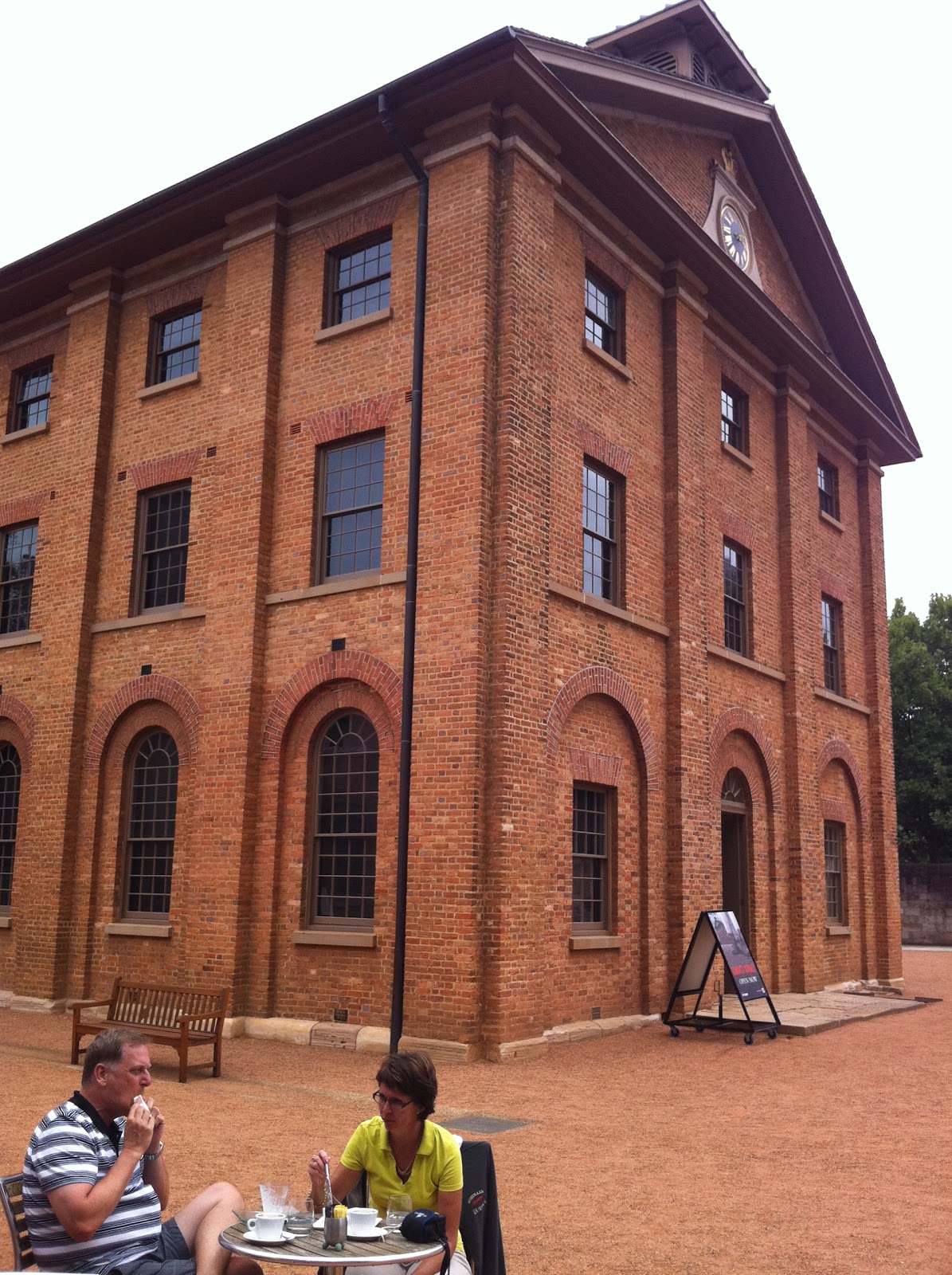
Coffee break at Hyde Park Barracks, Macquarie St, Sydney. The Barracks, designed by colonial architect Francis Greenway, is a world heritage listed building.
Sunday, 5 September 2010
South Head Signal Station


The lookout was established on 20 January 1790 by Captain John Hunter of H.M.S. Sirius, flagship of the First Fleet to signal the colony of Sydney Cove of any vessels arriving off the port.A flagstaff and timber huts were placed on site for crew members of the Sirius, who were placed in charge.
The present ston ebuilding was designed by colonial architect, Mortimer Lewis and erected by convict labour in about 1840 to replace the wooden huts.
The station is now staffed by members of the Australian Volunteer Coast Guard.
See and read more here, at Louise's blog : 52 suburbs.
Wednesday, 28 July 2010
Cockatoo Island Part 4
Sunday, 25 July 2010
Sydney Biennale - Cockatoo Island 1

Cockatoo Island, largest island in Sydney Harbour, former colonial prison, and one of Australia's largest shipyards in the 20th century. Lots of colonial heritage building (submitted for World Heritage Listing) and more recent maritime industrial buildings. And one of the venues of art installations in the Sydney Biennale. We're going to visit over the next couple of weeks.
Labels:
Art,
Cockatoo Island,
Harbour,
Historical,
history,
Industry
Wednesday, 14 July 2010
Le quartorze juillet

The Sydney suburb of Matraville contains many streets named after significant locations where ANZACs fought during World War One. Anzac Parade is a major Sydney artery. It was named in 1917 to commemorate the occasion when the AIF (Australian Infantry Forces) camped at Kensington Racecourse and paraded down that road on their way to embark for overseas service. Others streets include Amiens, Ypres, Pozieres, Menin, Flanders, Amiens, Bullecourt, Bapaume, Hamel, Armentieres. The local public school is called Soldiers Settlement.
I especially like the blue plates, commemorating in French the significance of the name, and reminiscent of the street name plates of France.
From the Randwick City Council web site:
"In 1917 a gift of 72.5 acres of Crown land, described as 'the waste sand hills beyond Daceyville, was made available for returned soldiers from World War I. A Voluntary Workers Association formed and between 1918 and 1925 some 93 homes were built, south west of Anzac Parade and Beauchamp Road, as the Matraville Soldiers' Garden Village... The houses eventually passed to the State Housing Board. In 1977 despite local protests, all but one of the cottages was demolished and the site redeveloped. The surrounding streets recall battlefields and sites of World War I."
Saturday, 12 June 2010
O'Hears Steps, Frog Hollow
Subscribe to:
Posts (Atom)