Showing posts with label Australia Day. Show all posts

Thursday, 26 January 2012

Australia Day: Invasion to Reconciliation (Parramatta)

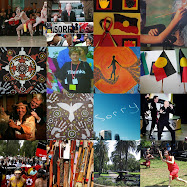
These images are part of the walkway along the Parramatta River.

On 26 January 1788, the First Fleet under Captain Arthur Phillip arrived in Sydney Cove. Parramatta, 23 kilometres west, was also established in 1788, after food growing failed in the poor soils around Sydney Cove. The indigenous Dharug people had known this as an area of rich food resources for thousands of years. It is the point where salt water becomes fresh, so also useful for farming.

Baludarri the Young Warrior, from Parramatta, befriended Governor Phillip and lived at Government House in Sydney from late 1790 to early 1791. He then left to return to Parramatta for a seasonal fishing trip, and encouraged by Phillip began to trade fish with new European residents of Parramatta.  

While fishing, convicts destroyed his fishing canoe. Phillip intervened and promised that the convicts would be punished if Baludarri did not kill a white man.  However, enraged at the act, Baludarri sought traditional revenge and speared a convict. Phillip learned of this and ordered Baludarri be outlawed and shot. Phillip later relented when he learned Baludarri had a fever. Baludarri died in late 1791 and was buried in the Governor's garden.

Between 1791 an 1805 a guerilla war was fought between Aboriginal people and whites. Aboriginal people defended their land ferociously from the appropriation following invasion. However, the arms available to the colonists ensured battle superiority. As well, the smallpox (an introduced disease ) epidemic of 1789 hit the Indigenous people very hard.

One leader, Pemulwuy, speared and killed Governor Phillip's gamekeeper, in revenge for the gamekeeper killing a large number of Aboriginal people. Phillip dispatched 50 soldiers with orders to bring back the hearts of any 6 men belonging to Pemulwuy's group. 

Pemulwuy led a series of attacks on farms. He was ambushed and killed in 1802. 

Reconciliation

In 1805, local Indigenous representatives and a settler, John Kennedy, initiated a 'Peace conference' at Parramatta. It was described as 'a conference with a view of opening a way to Reconciliation.' This was one of the earliest uses of the word in Australia - a first attempt at Reconciliation of Indigenous and non-Indigenous people in Australia.

This goal remains one to strive for.

Tuesday, 26 January 2010

Australia Day


It's Australia Day, 222 years since Captain Arthur Philip and the First Fleet lobbed in to Sydney Cove to begin gthe British Colony and appropriate the place from the locals.

So, amongst the myriad of things to do on this day, like become a new citizen (shown here in 2008) , on a bright summer Sydney day, lots of people whose origins lie elsewhere (like 98% of the population!) as well as descendents of the local Eora people, head to the beach for a picnic or barbecue.

Thursday, 29 January 2009

Out 'n' about at the Australian Open tennis


Top row:
Left:
Rod Laver Arena (the main court, named after one of Australia's most famous former players, the only two-times Grand Slam* singles winner, and one of only 2 men to do it) and Garden Square, where fans can sit and watch the action from inside RLA on a huge screen. A Grounds Pass costs as little as $30 a day, which gives you access to matches on the courts other than centre...you can still catch some great tennis.
Middle: A couple of French fans in Garden Square. The atmosphere is wonderful, with people from all over the world. And it's very relaxed and laid back (mostly)
Right: Part of the crowd inside Rod Laver Arena

Centre Row:
Left:
French fans inside RLA supporting Jo-Wilfried Tsonga
Middle: A new star is born
Right: Margaret Court Arena (aka Margaret Court court) named after another former great and Grand Slam winner - and she won two Mixed Doubles Grand Slams as well! The buildings in the background are in central Melbourne. One of Melbourne's great assets is the proximity of its great sporting venues to the city...just a short tram ride or easy walk.

Bottom Row:
Left:
View of Melbourne Park and the Yarra River from the 19th floor of the Grand Hyatt Hotel. Next door to the tennis centre is the Melbourne Cricket Ground (MCG), which was the Olympic Stadium in 1956
Middle: Players Box seats before the Tsonga/Blake match. We were sitting right near them, and during the match Tsonga's people occupied them.
Right: Line umpires and ball kids.

To see these photos enlarged, and others I haven't loaded from elsewhere, visit Sydney Daily Photo Extra.

* Grand Slam - winning the Australian, French, US Opens and Wimbeldon in one calendar year. A "Golden Slam" means winning those 4 AND an Olympic Gold. Does anyone know who the only player to achieve that feat was?

Tomorrow: back to Bronte

Monday, 28 January 2008

1997 Rockdale Citizen of The Year

Two days ago in my Australia Day post I mentioned the local Citizens of The Year. It took me a while to find the photos, but here is my mum, Alison, when she received the honour as Rockdale Citizen of the Year on 26 Jan 1997. I'm so proud of you, Mum.

Below: Kostya Tszyu - Sportsperson of the Year (he moved to the district in 1992, and he shares a birthday with mum - she's 41 years older), Rockdale Town Crier, Young Citizen of the Year - whose name I regret I don't know, June Salter, an actor who was Australia Day Ambassador, and was born in the local area, and Mayor Peter Bryant.


Postscript: Two days ago, a comment was left on my blog in response to my caption "Celebrate diversity: the faces of Australia". The comment was made by a member of a US organisation fighting for gay rights. The commenter said: "With the inclusion of the scouting movement who exclude gay people you are indeed not celebrating diversity but encouraging hatred against fellow Australians who just happen to be gay."

This is NOT the case in Australia, where the Scouting organisation does not have anti-gay rules. If you click here, you can read a transcript of an interview on our national broadcaster, the ABC, where this is made clear. In fact in Australia it is illegal to discriminate against people on the basis of sexual orientation, and the Scouts spokesperson said in no uncertain terms.

I would never want my blog to be seen to be, or indeed be, "encouraging hatred against fellow Australians who just happen to be gay." Indeed, have a look at my very first Daily Photo post from 19 April 2006.

Sunday, 27 January 2008

My first collage

Australia Day again. This is what I wanted to do yesterday but didn't know how. Thanks to Denton for pointing me in the Picasa direction :-)

Saturday, 26 January 2008

Straya Day, Carss Park on Kogarah Bay

Wandered down to Carss Park in time for the local Straya Day sarah-moanies. Australia Day commemorates the setting up of European settlement in Sydney Cove on 26 January 1788.

Started off well, with the Aboriginal didj player/MC very good. He welcomed us all to Country - the land of the Gadigal people of the Eora nation. Aboriginal dancers saw off any evil and negative thoughts, and a few brave souls got up and joined in corroboree when invited. The local sea scouts hoisted the flag and gave it a salute....and good thing they were there - they formed the core group of corroboree "volunteers".

They then went off in search of the BBQ, and I overheard one of the kids saying "it's gangsta" (that's the latest word for really, really cool, by the way) - whether he meant the dancing, the flag raising or the anticipation of a burnt snag, I know not.

A choir of smiling women sang the national anthem. Then the mayor and other local dig-er-nit-aries got hold of the mike and we became girt by speeches. The mayor made the most of his time and gave the same speech at least 3 times. The usual phalanx of pollies came and went, and the Australia Day Ambassador, a local identity, Dick Caine, a sports and swim coach told us about his days round Cullanulla in Banjo Paterson territory and introduced us to his family of multi-ethnic background - many of the kids he has taught to swim over the years. He was refreshing.

Cherie Burton, the member of state parliament for Kogarah added some laid back appeal, in her sleeveless top and thongs. She welcomed the Koori dancers to country, which was an interesting hands-across-the-sea reversal of fortunes. Poor old Robert McClelland, the local federal member - it was also his 50th b'day - attempting to keep the "dignified" in dignitary, musta been sweltering in his sports jacket and tie. But we did learn that he's best mates with Chris Evans, Minister for Immigration, who he also reckons is a real ugly bruiser.

Kevin Greene, andother state MP during his turn all but apologised for being born here and therefore never having CHOSEN citizenship.

As with all these things, it took about 12 speeches by blokes (and Cherie) to get to the moving bit - the proud new citizens swearing under God, or affirming to no God (sequentially) to be bonza Aussies. It was great seeing their smiling, proud faces. The choir sang some more.

Then they announced the local Citizens of The Year, which is nice in a parish-pump kinda way. Dick Caine also received that honour, which was a surprise to him.

The Queen's only appearance was by portrait, propped up by a nearby tree. She didn't get mentioned, and wasn't really able to be sighted, once the choir and swelling ranks of officialdom blocked her view of proceedings. I reckon sometime when we can agree on how to elect a President, we'll ease into Republicanism. Monarchy's pretty much a dead duck as far as local sarah-moany goes.

After that, on a bright beautiful, sunny 25 degree day, citizens old and new drifted off to the bbqs, camel rides and bouncy castle fun. It really was anything but a white bread affair, which is noice indeed. And the newest Australians all looked might chuffed.

Below: The Queen presided over events from the comfort of the garden, propped up by a tree:
Dance of various animals, including the emu:
Teaching volunteer participants the emu dance:
Corroboree:
The faces of people about to become citizens:


Taking the oath or affirmation:


Concentration:


The faces of Australia: Celebrate diversity!


Friday, 26 January 2007

Reconciliation - when? Not on Australia Day 2007.


This is a picture of Sydney Cove, taken from a significant point on the Sydney Harbour Bridge.

On 21 January, 1788, Captain Arthur Philip and the First Fleet, a raggle taggle collection of convicts and hardly-better British soldiers, reached Sydney Cove (the water in this picture) to establish a British convict colony.

On 26 January, the British flag was raised at Sydney Cove and the colony officially began.

Captain James Cook had sailed along the coast 18 years earlier, and had stopped in Botany Bay, south of here. Cook saw the entrance to the harbour on May 6, 1770, and named it Port Jackson, after a friend, one of the secretaries of the British Admiralty, George Jackson. He noted that it looked like a good anchorage, but decided to sail on, so he never entered this magnificent harbour. Cook, and his botanist, Joseph Banks, recommended a settlement at Botany Bay, however Philip found it did not possess a reliable fresh water supply, so after anchoring there on 18 January 1788, decided to move on to explore the possiblity of the anchorage at Port Jackson. Philip and the First Fleet arrived here on 21 January, and named it Sydney Cove. There was a stream, the Tank Stream, for water.

On 26 January, 1788, Philip raised the British flag and so founded the colony. That occasion id now commemorated as Australia Day, a public holiday.

That act also signifies the dispossession of the land from its original inhabitants, the Aboriginal people, although that was probably not the original intention.

A doctrine was used in British law, known as terra nullius (empty land) - now overthrown in Australian law. It asserte that the land was empty of people, and thus free for the taking. Cook had thought, because he encountered so few people around the coasts, that the interior must be empty.

In fact living in this very place were the Gadigal people of the Eora nation, Philip was under instructions to be friendly and to treat with them. A subsequent governor (Macarthur) went back to England to get terra nullius invoked, when he wanted to clear Aborigines from land he wanted to expand into.

This has led to more than 2 centuries of injustice towards the Aboriginal people.

At the southern end of the walkway across the Sydney Harbour Bridge, a plaque commemorates the Reconciliation Walk of 28 May 2000. On that say, there seemed like there was enormous hope for reconciliation between Australia's Indigenous and non-Indigenous people, as referred to yesterday. Under the policies of the current federal gocernment, that hope has dimmed - I hope temporarily. Now THAT will be a day to celebrate!!

The plaque reads:

On 28 May 2000, more than 250,000 people walked across the Sydney Harbour Bridge in support of reconciliation. In the months that followed a million more Australians participated in similar walks throughout the nation. Mari budjari yana. Unveiled on 27 May 2004