Showing posts with label pollution. Show all posts

Monday, 26 October 2009

NSW Maritime Environmental Services


This is how Sydney Harbour is kept clean. Photo taken at Campbell's Cove.

Information from the NSW Maritime website:

The operators remove floating litter and waste, including storm water pollution, other visible debris and floating hazards to navigation.

On average more than 3,500 cubic meters of rubbish is collected per year, ranging from large objects such as trees and tyres to the debris washed into the harbour from harbour side suburbs and small items left behind on beaches and other foreshore locations by people.

The Environmental Services team also manages the free sewage pumpout stations at Blackwattle Bay and King Street wharf. They monitor the use of other free public fixed pumpout facilities available in Sydney Harbour to recreational and commercial vessels operators.

Historical background

In the early 1900s the Environmental Services team’s predecessors were known as the “rat catchers” of Sydney, formed to combat the spread of the Bubonic Plague. The trapping of infected rats was a vital service to the health of Sydneysiders.

In the 1930s, the “rat catchers” became the Harbour Cleaning Service. In timber boats a crew of hardy souls who didn’t mind the salt, spray or the smell, would collect debris and floating rubbish. The retrieval of dead animals and other unsavoury objects from Sydney Harbour was a common task.

In the 1950’s the wooden boats gained the luxury of engines but it was the greater environmental awareness stemming from the “Clean Up Australia” campaign that instigated the purchase of the present harbour cleaning equipment in June 1989.

In 1990, the NSW Maritime Authority took on the responsibility for cleaning Sydney Harbour as a major environmental initiative.

The role of the Harbour Cleaning Branch changed to Environmental Services in 2002. It has grown in conjunction with the NSW Maritime's enhanced responsibilities as an Appropriate Regulatory Authority under the State's environment protection laws. It demonstrates an increased environmental engagement and provides a stronger focus on environmental performance within commercial and recreational vessel fleets on Sydney Harbour. An additional duty, for example, involves monitoring compliance by contracting and building companies regarding deployment of anti-pollution booms and skirts around foreshore construction sites.

Today’s Environmental Services Branch has a team of 15, who work the vessels on a seven day per week schedule.

The team and its equipment is also used to provide operational support to the major events on and around Sydney Harbour. These events include the Sydney to Hobart Yacht Race Start on Boxing Day, New Years Eve and Australia Day, for which marker buoys are laid to indicate safety exclusion zones on the harbour.

For several years, Environmental Services has also been conducting a Joint Foreshore Cleaning Project. Local Council areas nominate foreshore areas to be cleaned in a land based operation, labour is provided through the Department of Corrective Services Community Service Order and Periodic Detainee Rehabilitation Program, Clean Up Australia’s bus is loaned to the project with all planning, transport and supervision provided by the Harbour Cleaning Service. Councils bear the cost of transport and disposal of rubbish collected.

The vessel

These purpose built vessels are 10.5 meters in length and powered by twin 150hp outboard engines. The power operated ramp allows direct access to beaches and enable transport of beach cleaning equipment to and from appropriate locations. The on-board crane and addition of surface skimming equipment allows these vessels to provide fast response for almost any cleaning requirement, and are listed as support vessels in the Oil Spill Response Plan for Sydney Harbour.

Thursday, 28 June 2007

Carp Catching at Birrong


Sometimes serendipity leads you to be in the right place at the right time!

Yesterday I was working at Birrong, a south-western Sydney suburb. I decided to check out a green patch on the street map called Maluga Passive Park. As I neared the duck pond, I saw a boat on the other side. One of the fellows waved at me, and I waved back. They headed over to where I was standing. I asked them what they were doing, and they told me to lift the lid on one of the bins by the side (Picture 2), and it turned out they are contracted to clear the pond of the noxious fish, European and Koi carp (Cyprinus carpio), and goldfish (Carassius auratus). Koi carp, which are an ornamental strain, revert to their natural colour in the wild.

They then demonstrated their technique, and held up the "victim" for me (Picture 1). Then they headed out again (Pics 3 & 4)

Home to Google, and I found out from the council website that introduced noxious fish can severely impact the health of aquatic ecosystems by increasing water turbidity and nutrient concentrations, destroying aquatic plants, and potentially causing the recurrence of toxic blue-green algae blooms. They also breed rapidly, eliminating native fish, tadpoles and other small lifeforms. They use electrofishing, which involves passing a small electric current through the water to stun fish. Native fish are released unharmed and exotic fish are euthanased. Electrofishing took place in in 2003 and 2005. In November 2003, native Australian Bass (Macquaria novemaculeata) fry - they are native to the local area - were introduced to re-establish a healthy breeding population that are predators of introduced fish - they eat nuisance algae and carp eggs.

European Carp are mainly bottom feeders and tend to stir up sediments, increasing turbidity and releasing nutrients such as nitrogen and phosphorus into the water. In this way, carp contribute to toxic blue-green algal blooms in freshwater.

Bankstown Council continues to monitor and remove carp to ensure that the Bass survive and water quality is not further degraded. And that's what these blokes were doing!


Wednesday, 27 June 2007

Butt Busting


Smoking is already banned in workplaces, and many smokers congregate on footpaths outside buildings. Often to get into a building you have to walk past a small gaggle of cancer-stick puffers and their smoky fugue. It can cause problems for air intake vents, which may recirculate smoke through air conditioning systems.
From July 1, there will be a ban on indoor smoking in pubs and clubs. City of Sydney staff and City Rangers will be out and about today accompanied by City of Sydney Butt Busters talking to people about the pollution caused by cigarette butt littering.

Squads of butt busters will target litter hotspots handing out 10,000 free personal ashtrays and encouraging business to join the City of Sydney's Clean Harbour Partners program where they can apply for a free wall-mounted ashtray valued at $350.

City of Sydney Acting CEO said: "We're reminding people that cigarette butts littering Sydney streets get washed down the stormwater drain and end up in Sydney Harbour or on Bondi Beach.
"What seems like a small piece of litter is the most commonly discarded litter item in NSW and is a massive environmental issue."

A City of Sydney study in the CBD, Kings Cross and Glebe found there were more than 15,000 butts thrown away every day - which is about 5.4 million butts potentially going straight into Sydney Harbour.
The City of Sydney has also warned that its plain-clothed City Rangers will step up their operations in late July targeting litterers.
The City Rangers have the power to issue $60 on the spot fines for littering and $200 on the spot fines for littering a lit cigarette butt.

Can you see a time when smokling will be banned in all but your own home? Even then, some people in apartments complain about cigarette smoke entering their space from others' smoking on balconies. It seems evident to me that restrictions on smokign will continue to increase. Which, as a non-smoker, I don't mind at all!

Saturday, 10 March 2007

Garden, not ash tray


This sign might have a little more meaning if, well, if the garden had a bit more....garden. It is in a spot where office workers congregate to smoke. Unfortunately, too many smokers seem to think that their butts are someone else's problem to dispose of! It was cleaned up just before the sign appeared, but it didn't take long for the butts to start appearing again.

Sunday, 23 April 2006

Graffiti and Pollution Rant


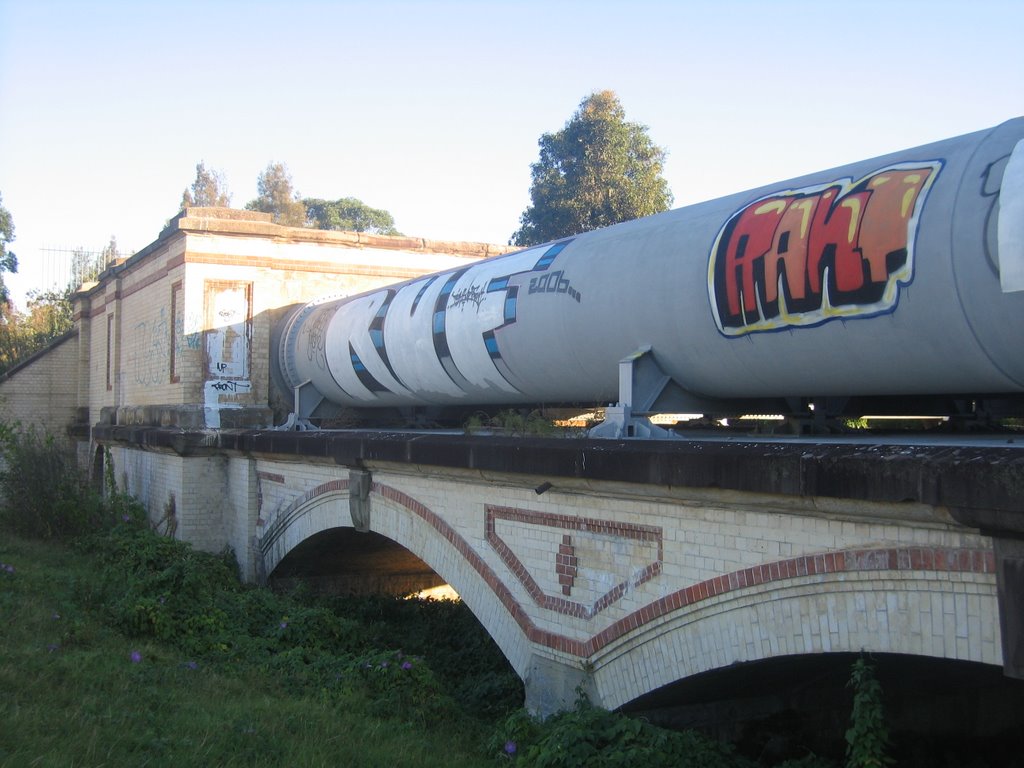
Graffiti art adorning the South Western Sydney Ocean Outfall Sewer aqueduct.

Yes, Sydney still pumps its sewerage into the ocean at various points. This lot, the effluent of 1.69 million people, goes to the treatment centre at Malabar before being discharged via the deep ocean outfall, 3.6 kilometres offshore. Out of sight, out of mind.

It is treated to a certain extent - called "high rate primary". Sydney Water tells us that primary treatment takes out solid matter such as paper, cotton tips and plastic. Heavy particles like sand sink to the bottom and are removed. The sewage then flows into the primary sedimentation tanks. Here human waste, called sludge, settles to the bottom and oils and grease float to the top where they are collected.

High-rate primary treatment occurs at high flow rates and removes fewer solids.

Sydney and NSW politicians have shown a distinct reluctance to consider proper recycling of effluent. The previous Minister responsible for water, Frank Sartor inflamed matters by saying that Sydneysiders were not prepared to drink recycled sewage, even if it was treated to drinking water standard and safe. You can read more of his wisdom here. Plenty of Sydney-siders reckon otherwise.

This despite the fact that Sydney is in the grip of drought.

So, which is the greater crime - some graffiti tags and a couple of abandoned spray cans, or the continued use of the Pacific Ocean as a sewer? You decide.